Solar energy has become one of the most popular and cost-effective renewable energy solutions for homes, businesses, and industrial projects. Yet one common question remains: Do solar panels need direct sunlight to work? The short answer is no—solar panels can generate electricity even without direct sunlight. However, their efficiency and output will vary depending on weather conditions, panel quality, and installation location.
In this article, we’ll explore how solar panels work, how they perform in different lighting conditions, and what factors affect their overall efficiency.
How Do Solar Panels Work?
Solar panels convert sunlight into electricity through the photovoltaic (PV) effect. Each solar panel contains multiple photovoltaic cells, typically made from silicon. When sunlight hits these cells, photons excite electrons, creating an electric current.
This process does not require heat. Instead, it relies on light particles (photons). That means solar panels can produce electricity even on cold days, provided there is sufficient daylight.
Do Solar Panels Require Direct Sunlight?
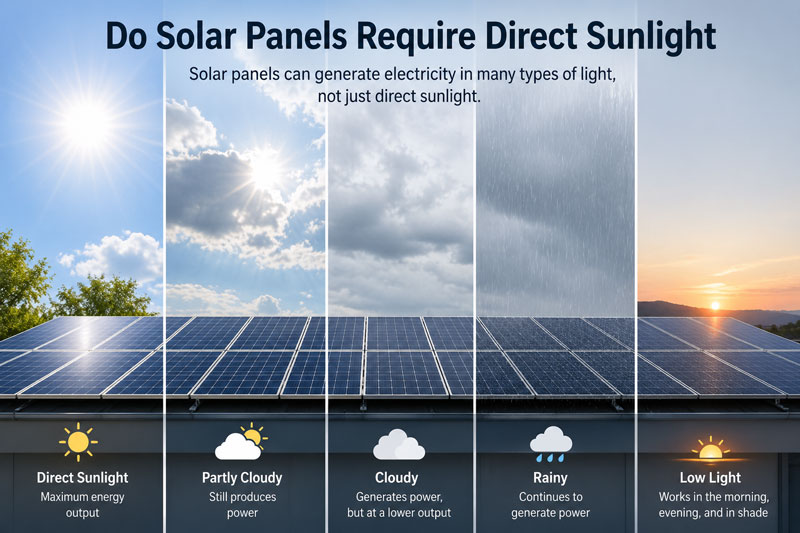
No, solar panels do not require direct sunlight to generate electricity. They can still produce power from indirect sunlight or diffuse light, which occurs when sunlight is scattered by clouds, haze, or atmospheric particles.
Even on cloudy or overcast days, solar panels continue to work. Although their output is reduced compared to clear, sunny conditions, they still generate usable electricity.
Solar Panel Performance in Different Conditions
- Bright, direct sunlight: Maximum energy production.
- Partly cloudy weather: Moderate to high energy output.
- Overcast skies: Reduced output, typically 10% to 25% of peak capacity.
- Rainy days: Minimal but still measurable electricity generation.
- Snowy conditions: Panels can still work if not fully covered, and snow reflection may even improve performance once the panels are clear.
How Efficient Are Solar Panels on Cloudy Days?
Modern solar panels are remarkably efficient, even under less-than-ideal weather conditions. On cloudy days, most panels generate between 10% and 25% of their rated output, depending on cloud density and panel technology.
Some advanced panel types, such as monocrystalline solar panels, perform better in low-light conditions than older or lower-grade alternatives.
Countries with Less Sunshine Still Benefit from Solar Power
A common misconception is that solar panels are only effective in hot, sunny climates. In reality, countries with moderate or even cloudy weather successfully use solar energy.
For example, Germany is a global leader in solar power adoption despite receiving less annual sunshine than many other countries. Similarly, regions with frequent cloud cover can still achieve strong returns on solar investments.
Factors That Affect Solar Panel Performance
While direct sunlight delivers the highest output, several other factors influence solar panel efficiency:
1. Panel Type
- Monocrystalline panels: Highest efficiency and best low-light performance.
- Polycrystalline panels: Good performance at a lower cost.
- Thin-film panels: Lightweight and flexible but generally less efficient.
2. Installation Angle and Orientation
Proper tilt and orientation maximize exposure to available sunlight throughout the day.
3. Temperature
Contrary to popular belief, excessive heat can reduce solar panel efficiency. Solar panels often perform better in cool, sunny conditions.
4. Shading
Partial shading from trees, buildings, or debris can significantly reduce output. Even a small shaded area can affect the performance of an entire panel string.
5. Cleanliness and Maintenance
Dust, dirt, leaves, or snow accumulation can block sunlight and lower energy production. Regular cleaning helps maintain optimal performance.
Can Solar Panels Work at Night?
Solar panels do not generate electricity at night because they need sunlight to produce power. However, this does not limit solar energy systems.
Most solar installations use one or both of the following solutions:
- Battery storage systems to store excess daytime energy for nighttime use.
- Grid connection to draw electricity from the utility grid when solar production is unavailable.
Tips to Maximize Solar Panel Efficiency
To get the most out of your solar investment:
- Choose high-efficiency solar panels.
- Install panels in an unshaded location.
- Optimize panel tilt and orientation.
- Perform regular cleaning and maintenance.
- Consider adding battery storage for energy independence.
- Work with a professional installer for system design and placement.
Final Thoughts
So, do solar panels need direct sunlight to work? No, they do not. Solar panels can generate electricity using both direct and indirect sunlight. While direct sunlight produces the highest energy output, modern solar technology remains effective even on cloudy, rainy, or cold days.
This makes solar energy a practical and reliable solution in a wide range of climates. Whether you live in a sunny region or an area with frequent cloud cover, solar panels can still provide substantial energy savings and environmental benefits.